Hearing Health & Wellness
Your Hearing Is About More Than Sound
Most people think about hearing care only when something seems wrong. But hearing health is deeply connected to your overall wellbeing — your brain, your balance, your mental health, your relationships, and your quality of life. At Casco Bay Hearing, we believe that understanding your hearing is an important part of understanding your health at every age and stage of life — whether or not hearing aids are ever part of the conversation.
Hearing and Brain Health — What the Research Tells Us
The connection between hearing and brain health is one of the most significant and compelling areas of current medical research — and the findings are impossible to ignore.
Epidemiologic studies have linked hearing loss to nearly two times greater risk of dementia. A landmark study published in JAMA and led by researchers at the Johns Hopkins Bloomberg School of Public Health found that older adults with greater severity of hearing loss were more likely to have dementia. Importantly, researchers also found that addressing hearing loss was associated with reduced dementia likelihood — suggesting that proactive hearing care may play a meaningful role in protecting long-term brain health.
In 2023, the NIH funded a large-scale randomized clinical trial — the ACHIEVE Study — led by Dr. Frank Lin at Johns Hopkins University, published in The Lancet. The study found that older adults at greater risk of dementia may be able to decrease their risk of cognitive decline by nearly half through hearing intervention — the first randomized controlled trial of its kind to examine this question directly.
Researchers at Johns Hopkins describe hearing as a potentially modifiable risk factor for dementia — meaning it is something we can actually do something about. As otolaryngologist Carrie Nieman of the Cochlear Center for Hearing and Public Health states: "The exciting part is that hearing is something we can address, making it a potentially modifiable risk factor."
Source: Johns Hopkins Bloomberg School of Public Health; JAMA, 2023; The Lancet, 2023; National Institutes of Health; Johns Hopkins Medicine, 2024
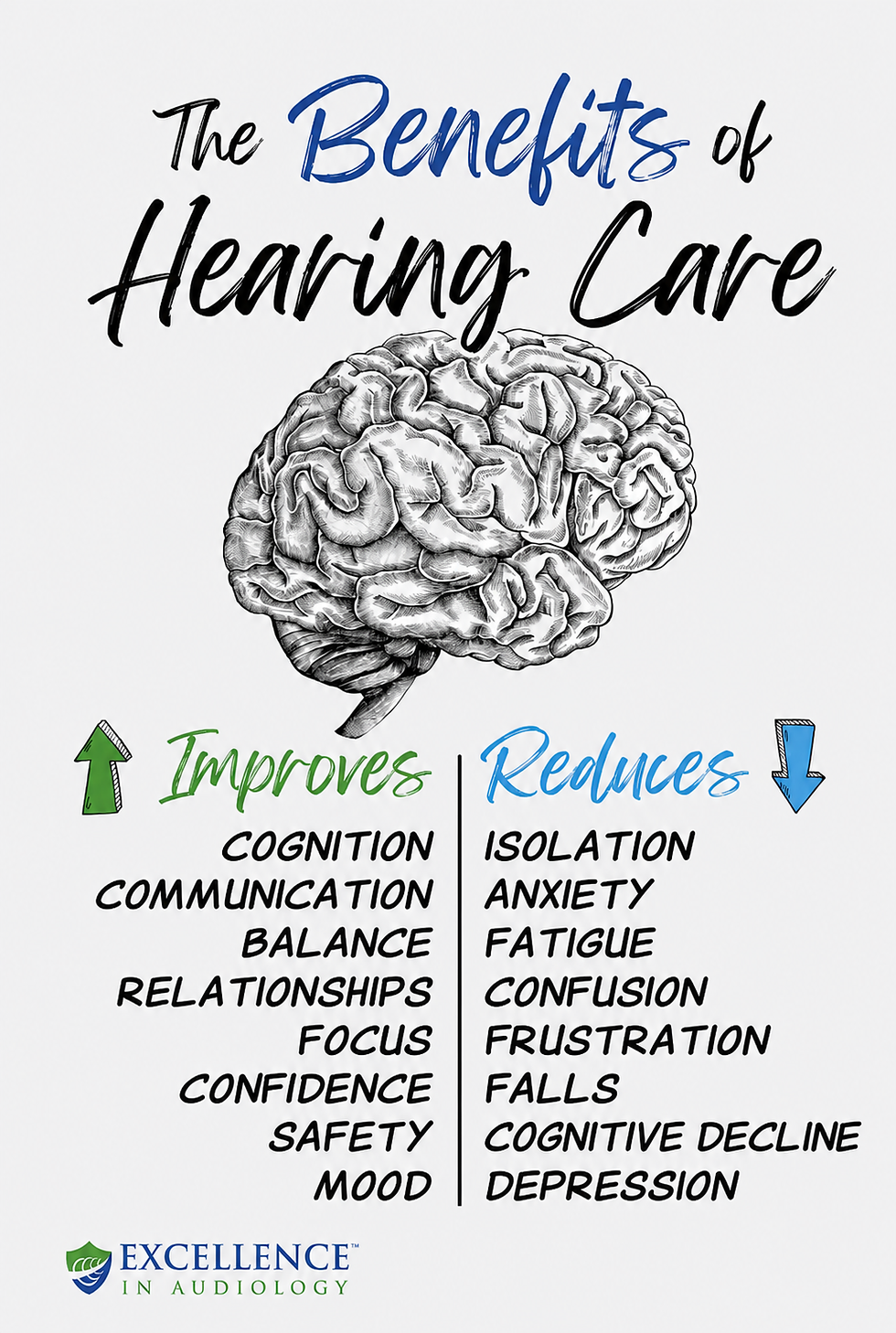
Image courtesy of Excellence in Audiology
Cognitive Load — The Hidden Mental Effort of Struggling to Hear
Even before a formal hearing evaluation, straining to hear in everyday situations takes a measurable toll on the brain. When the auditory system is working harder than it should, the brain is forced to redirect cognitive resources — energy that would otherwise support memory, focus, and processing — toward the effort of simply understanding speech. This is known as cognitive load.

Research indicates that untreated hearing difficulties contribute to increased cognitive load and neural atrophy — key drivers of cognitive impairment over time. This constant mental effort can contribute to fatigue, difficulty concentrating, and reduced capacity for the cognitive tasks that support daily life.
This is one of the reasons many people with unaddressed hearing difficulties report feeling exhausted after social situations — not because they are tired, but because their brain has been working overtime simply to follow conversations.
Auditory training is one approach that can help strengthen the brain's ability to process and interpret sound. As part of our commitment to long-term hearing wellness, we provide patients with access to auditory training resources that can be used independently at home — supporting the brain's connection to sound and reinforcing listening skills over time, regardless of where someone is in their hearing health journey. We are happy to discuss these resources at any appointment.
Source: National Center for Biotechnology Information; Alzheimer's Association, 2026
Social Isolation, Loneliness, and Mental Health
Hearing difficulties don't just affect what we hear — they affect how we connect. When following conversations becomes a source of frustration or embarrassment, many people quietly begin to withdraw from the social situations they once enjoyed. Over time, this withdrawal can become a pattern — and that pattern carries serious health consequences.
A growing body of evidence published through Johns Hopkins School of Medicine has linked age-related hearing loss to functional decline, depression, cognitive decline, and dementia. Hearing loss has been identified as the largest potentially modifiable risk factor for dementia, accounting for approximately 9% of dementia cases globally.
Research consistently shows that hearing loss is associated not only with social isolation and loneliness, but with depression and anxiety as well. Early attention to hearing health — through evaluation, awareness, communication strategies, and when appropriate, intervention — may help modify this risk.
The path from hearing difficulty to isolation is often gradual and invisible — which is why proactive hearing care matters long before the effects become obvious.
Source: Johns Hopkins School of Medicine, PMC; Neurology Advisor, 2025
Hearing Health and Fall Risk
The inner ear is home to both the cochlea - responsible for hearing, and the vestibular system - responsible for balance. It is no coincidence that hearing difficulties and balance challenges often occur together.
Research published in the National Library of Medicine found that for every 10 dB increase in hearing loss, there was a 1.4-fold increased odds of reporting a fall over the preceding 12 months. A 2025 systematic review and meta-analysis found that hearing loss was associated with meaningfully higher fall odds across multiple studies, and that addressing hearing may support improvements in postural stability.
Falls are one of the leading causes of injury and hospitalization in older adults. Understanding the role that hearing plays in balance and spatial awareness is an important, and often overlooked, piece of comprehensive fall prevention and overall safety.
Source: National Library of Medicine; Frontiers in Aging, 2025; Journal of the American Geriatrics Society, 2023
Hearing Health and Comorbidities
Hearing health rarely exists in isolation. Research has established meaningful connections between hearing and a number of systemic health conditions, reinforcing the importance of viewing hearing as part of your overall health picture rather than a separate concern.
Type 2 diabetes, hypertension, coronary artery disease, and cardiovascular disease have all been associated with accelerated hearing loss. The cochlea is a highly vascularized organ — it depends on healthy blood flow to function properly, making it particularly vulnerable to conditions that affect circulation throughout the body. Research suggests that individuals with two or more cardiovascular risk factors may have a significantly higher risk of experiencing hearing loss.
This bidirectional relationship is important — hearing health may reflect broader health, and broader health affects hearing. It is one of the reasons we believe in a collaborative approach to care, working alongside primary care providers and other healthcare professionals to ensure hearing health is understood in the full context of each patient's overall wellbeing.
Source: Scientific Reports, Nature, 2025; JAMA Otolaryngology; The Cardiology Advisor
Tinnitus — More Than Just Ringing in the Ears
Tinnitus — the perception of ringing, buzzing, humming, or other sounds without an external source — affects millions of people and is often misunderstood as simply a symptom of hearing loss. While the two are frequently connected, tinnitus is a complex condition influenced by many contributing factors, and understanding it requires looking at the whole picture.
Hearing loss is the most common factor associated with tinnitus, and the perceived pitch of tinnitus often corresponds to the frequencies affected by hearing loss. However, not everyone with hearing loss develops tinnitus, and not everyone with tinnitus has measurable hearing loss — illustrating that it is rarely a simple one-to-one relationship.
Beyond hearing loss, research has identified a range of factors that can contribute to or worsen tinnitus, including:
- Noise exposure — occupational and recreational noise are among the most well-documented contributors
- Cardiovascular factors — impaired cochlear blood flow, hypertension, and hypercholesterolemia have been linked to tinnitus development
- Stress and anxiety — perceived stress can trigger or worsen tinnitus, and tinnitus itself can become a source of significant stress, creating a cycle that is difficult to break without support. Research suggests that between 28–45% of chronic tinnitus patients present with clinically relevant anxiety symptoms
- Medications — certain medications including some antibiotics, diuretics, and chemotherapy agents are known to affect the auditory system
- TMJ disorders — temporomandibular joint dysfunction has been identified as a contributing factor in some individuals
- Sleep disturbances — poor sleep can both contribute to and be worsened by tinnitus, affecting overall health and quality of life
- Overall health and lifestyle factors — including diet, activity level, and general health management
Research has also found that tinnitus may be a potentially modifiable risk factor for cognitive decline, and has been associated with an increased risk of neurologic disorders — further connecting hearing health to broader brain health.
At Casco Bay Hearing, we take a thorough and individualized approach to tinnitus support, considering all of the contributing factors that may be relevant for each patient. When appropriate, we collaborate with other healthcare providers to support a more comprehensive picture of care.
Source: NCBI/PubMed; Hearing Health Foundation; PMC — The Association Between Stress, Emotional States, and Tinnitus, 2023; Tinnitus and Cardiovascular Disease — The Tromsø Study, 2025; Alzheimer's Association, 2026
Hearing Care as Part of Your Wellness Routine
You wouldn't skip an annual physical or postpone an eye exam indefinitely — and hearing deserves the same proactive attention.
Hearing changes gradually, and most people adapt so slowly that significant changes go unnoticed for years. By the time hearing difficulties become undeniable, the effects on brain health, relationships, and quality of life may already be underway. A hearing evaluation doesn't require a problem — it requires an interest in understanding where you stand.
Proactive hearing care looks different for every person. For some it means a baseline evaluation and peace of mind. For others it means understanding contributing lifestyle or health factors. For others still it means exploring strategies, resources, and — when clinically appropriate — hearing technology that can make a meaningful difference. Whatever the path, it begins with information.
We welcome patients at every stage — those experiencing noticeable changes, those who simply want a clear picture of their hearing health, those referred by a physician, and those who believe that proactive care is simply the right approach to living well.
Your hearing is worth understanding. We're here to help.
References
Huang et al. Hearing Loss and Dementia Prevalence in Older Adults in the US. JAMA, 2023. doi:10.1001/jama.2022.20954
Lin F. et al. Hearing Intervention versus Health Education Control to Reduce Cognitive Decline. The Lancet, 2023.
National Institutes of Health. Hearing Aids Slow Cognitive Decline in People at High Risk. nih.gov, 2023.
Johns Hopkins Medicine. How Does Hearing Loss Link to Cognitive Decline? hopkinsmedicine.org, 2024.
Reed N. et al. Hearing Loss, Loneliness, and Social Isolation: A Systematic Review. PMC, 2020.
Darrow K. Hearing Loss & Tinnitus — Reducing the Risk of Cognitive Decline. Alzheimer's Association, 2026.
Lin F. et al. Hearing Loss and Falls Among Older Adults in the United States. National Library of Medicine.
Frontiers in Aging. Age-Related Hearing Loss and Balance Disorders. 2025.
Scientific Reports, Nature. Association of Hearing Loss with Cardiovascular and Mortality Risk. 2025.
Wattamwar K. et al. Association of Cardiovascular Comorbidities with Hearing Loss in the Older Old. JAMA Otolaryngology, 2018.
PMC. Tinnitus: Clinical Insights in its Pathophysiology. 2024.
PMC. The Association Between Stress, Emotional States, and Tinnitus. 2023.
PMC. Tinnitus and Cardiovascular Disease — The Tromsø Study. 2025.
Hearing Health Foundation. 10 Tinnitus Triggers You Should Know. hearinghealthfoundation.org